

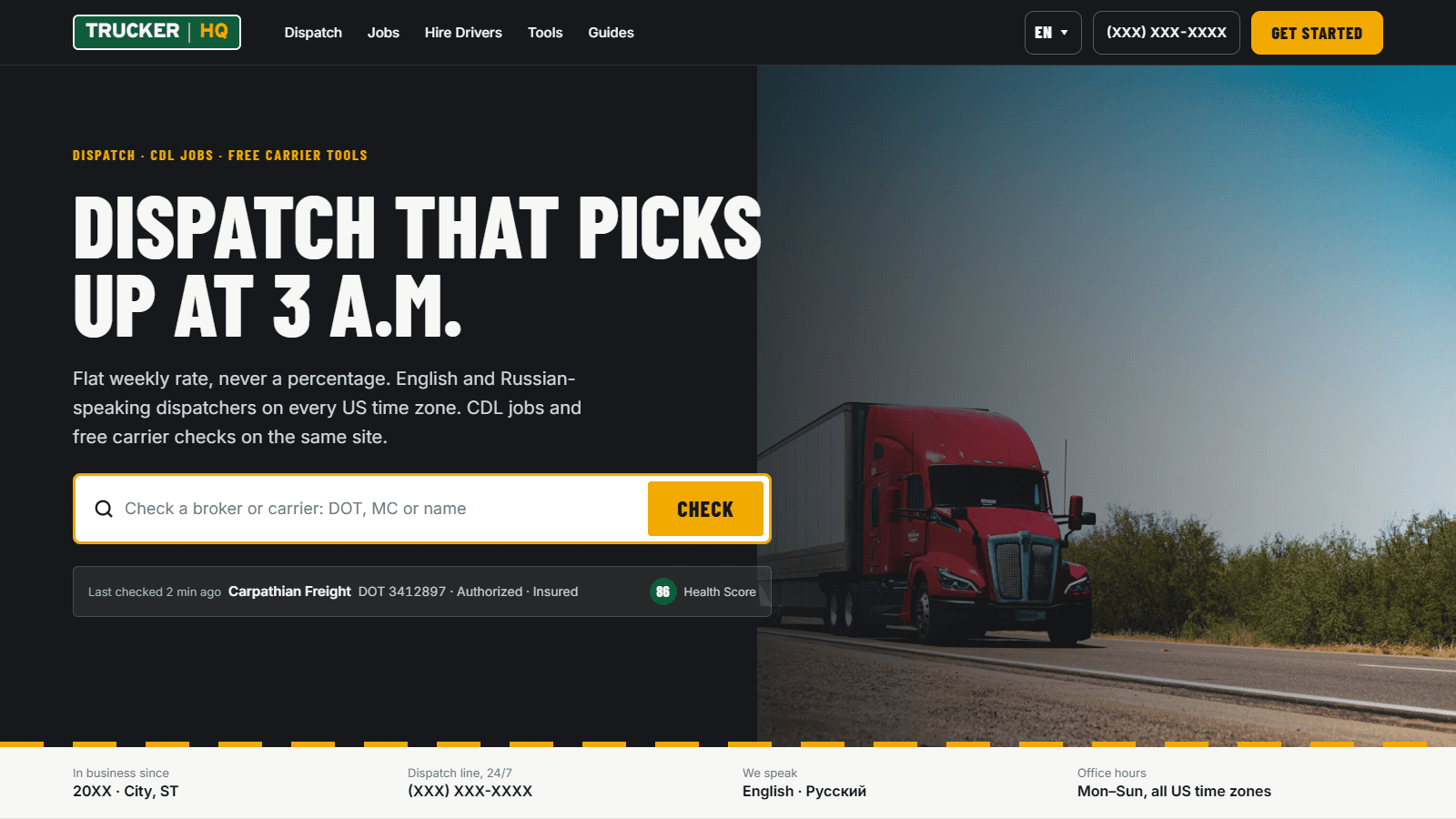
We built a platform for Trucker HQ that brings in dispatch clients through free tools for truck carriers
Owner-operators and small US fleets check their authority, work out profit per mile and find jobs. When they need a dispatcher, the request goes straight to the team and the driver gets a confirmation text.
The business problem
Trucker HQ provides dispatch for owner-operators and small US fleets, many of whom speak Russian. Dispatch is usually sold as a percentage of every load. Trucker HQ wanted to offer a flat weekly price, but a new model has to be explained and proven, and the right carriers have to be found first.
Small carriers have daily needs that have nothing to do with a dispatcher: checking their authority and insurance in the federal FMCSA registry, working out whether a load pays, finding drivers or a job. The information exists, but it is scattered, technical and English-only. Without a place these people come to on their own, every new client cost sales time and paid ads.
Find, together with the client, a way to bring small carriers to the site through genuinely useful tools, so that those who need a dispatcher leave a complete request without a qualifying call.
- Public but sensitive dataA DOT or MC number can identify a sole proprietor; these numbers never reach ad platforms, and the forms save data without being able to read it back from the browser
- Regulated SMS in the USTexts need explicit consent, a STOP option and an SMS terms page; sends are capped so the forms can't be abused
- Two languages, not a translationThe audience speaks English and Russian; the main pages exist in both, with Cyrillic fonts and correct signals for Google
- UsersDrivers on a phone, in a cab: short forms, large buttons, no account and no password
- Data from a third-party systemThe FMCSA registry publishes no response schema, so its data is mapped to our own model, with our own carrier health score
The solution
We did not start with screens. We started from the people who will use the site: the owner-operator with one truck, the fleet with 3–10 trucks, the carrier with a new authority, the CDL driver looking for work and the company hiring. For each we worked out with the client what they look for, what data they give us and where it goes: dispatch requests to dispatchers, applications to recruiters, alert sign-ups to the database. We also prepared an SEO plan, an ads plan and a content checklist for the client to fill in.
Then we built the platform along the user's path. A carrier lands from Google on their state or city page, or on a free tool, checks a carrier by DOT or MC, works out the profit on a load. Every tool has a natural next step into dispatch: a form that collects exactly what a dispatcher asks on the first call. The request is saved to the database, and the carrier gets a confirmation text right away.
- We started from the visitor types and worked out for each what they look for, what data they give us and where it goes.
- The tools are free with no sign-up, to bring search traffic and build trust before any sale.
- The flat price sits next to a calculator comparing it to a percentage dispatcher, so carriers see their own saving.
- Packages are split by the carrier's stage, not by what we would like to sell.
- Thin pages are kept out of Google, so the site is not penalised for duplicate content.
- The carrier panel with accounts was postponed: we validate demand with simple forms first.
- Web appA fast, search-ready site in English and Russian, with pages generated for every state, city, job and guide
- Cloud databaseSafely stores every request: dispatch, applications, hiring, contact, alerts, profile claims
- Government data integrationLooks up carriers in the federal FMCSA registry by DOT, MC or name and computes a health score
- SMS gatewaySends instant confirmations after a request, with consent and abuse protection
- Analytics & ads trackingMeasures which pages and tools bring requests, with cookie consent and no personal data sent to ad platforms
- Search visibilityStructured data, share images and a sitemap for every page type
Screens with demo data
What we found midway through
FMCSA data arrives incomplete or delayed, and an access key isn’t required at the start. The site runs on sample data until the key is set, then switches to live data with no other changes.
The Russian version needs Cyrillic fonts and copy written for drivers, not translated word for word. We split copy by language and put it through a dedicated review.
The header was rebuilt as a road sign, with the dispatch phone number always visible. On phones, primary buttons grew to at least 48 pixels for drivers using the site from the cab.
What the client gained
The client has one place small carriers come to on their own: from searches for their state, their city or their DOT number. Every request arrives complete and structured, with equipment, lanes and the best time to call, so the dispatcher starts the conversation already knowing who they are talking to.
The carrier gets a confirmation on the spot, the team sees in analytics which pages and tools bring in clients, and Russian speakers find the service in their own language.
What it looks like
Screens with demo data
Have a similar project?
- Running a two-branch kindergartenWindows desktop app →
- Orders and stock for a flower shopInternal management web app →
- Startica, new website and events panelBusiness website with admin panel →
- Bilingual site for a wine consultantBilingual business website →
- A website that turns visits into enrolmentsBusiness website, brand and marketing →
- SwissCars.md: Swiss cars, onlineBusiness website with admin panel →
- Mees 68, interactive building mapWeb app →
- AS Factorum: industrial business websiteBusiness website →
- Website for FC ScânteiaSports club website →
- A digital twin for a trucking fleetWeb app →
- Kindergarten app, modular kindergarten managementSaaS platform · Web admin application →